Author: think1023

  • Why SF₆ Gas Is Used in Switchgear: Technical Guide

    Why SF₆ Gas Is Used in Switchgear: Technical Guide

    Why Is SF₆ Gas Used in Switchgear? The Complete Technical Guide

    Introduction: The Gas That Made Modern Switchgear Possible

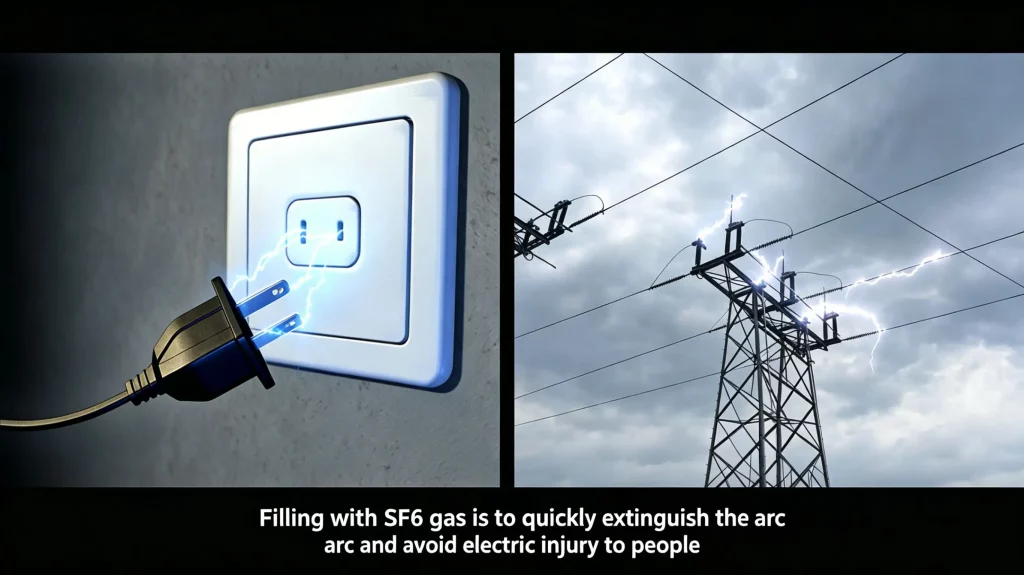
    Diagram showing how SF6 gas in switchgear provides electrical insulation and arc quenching.

    SF₆ gas in switchgear has supported medium-, high-, and ultra-high-voltage power systems for decades. It is the primary insulating medium in gas-insulated switchgear (GIS), helping utilities and manufacturers build compact equipment with dependable insulation and interruption performance.

    Sulfur hexafluoride is colorless, odorless, non-flammable, and chemically stable under normal operating conditions. At 20°C and standard atmospheric pressure, its density is approximately 6.16 g/L—about five times that of air. These characteristics, combined with excellent dielectric strength and arc suppression, explain why SF₆ is used in GIS worldwide.

    The Four Key Reasons SF₆ Is Used in Switchgear

    1. Superior SF₆ Gas Insulation

    SF₆ is an electronegative gas. Its molecules capture free electrons and form relatively heavy negative ions that cannot easily accelerate and cause an electron avalanche. This suppresses electrical breakdown between energized conductors and grounded enclosures.

    As a result, SF6-Gasisolierung allows smaller clearances than air insulation. Manufacturers can therefore produce equipment with:

    • Smaller installation footprints
    • Higher voltage ratings in enclosed systems
    • Reduced material requirements
    • Better protection from dust, moisture, and contamination
    • Improved operational safety

    2. Exceptional SF₆ Arc-Quenching Properties

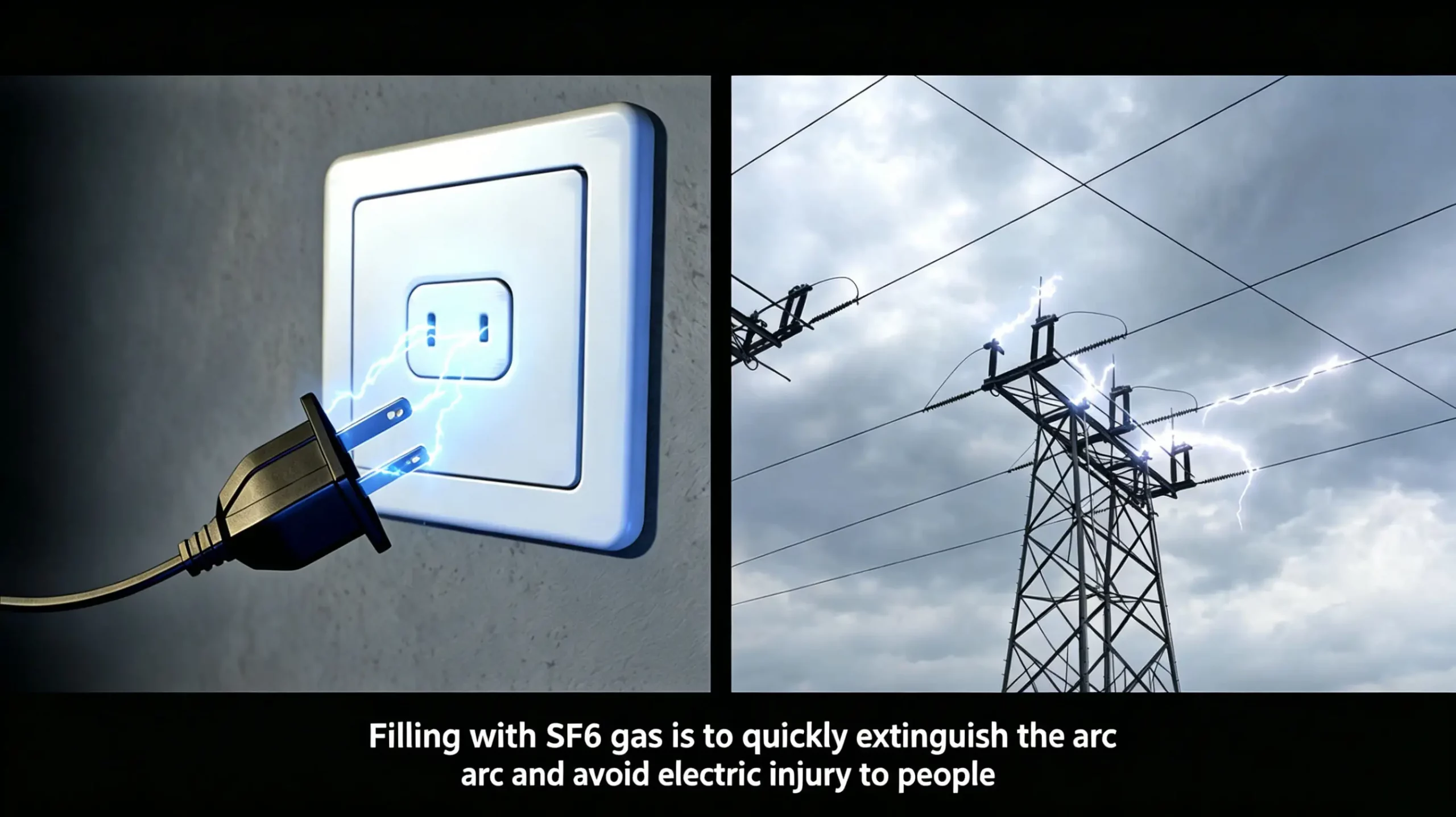
    When circuit-breaker contacts separate under load or fault conditions, an electrical arc forms between them. SF₆ rapidly captures electrons, removes heat from the arc channel, and restores dielectric strength after current zero.

    The widely recognized SF6-Lichtbogenlöscheigenschaften can extinguish an arc significantly faster than air—often cited as approximately 100 times faster under comparable conditions. This makes the gas highly effective in high-voltage circuit breakers where rapid, reliable fault interruption is essential.

    3. Compact Equipment Design

    The combination of dielectric strength and arc-quenching performance enables SF6 gas-insulated switchgear to occupy only a fraction of the space required by conventional air-insulated equipment.

    This compact design is especially valuable for:

    • Urban substations with expensive land
    • Underground or indoor installations
    • Offshore platforms
    • Industrial plants
    • Hydropower stations
    • Sites exposed to salt, dust, or severe weather

    4. Chemical Stability and Operational Safety

    SF₆ is non-flammable, chemically inert, and thermally stable under normal switchgear conditions. It generally does not react with common equipment materials, supporting long service life and predictable performance.

    However, electrical arcs can create decomposition products such as SOF₂, SO₂F₂, SF₄, and SO₂. Maintenance personnel must therefore use appropriate protective procedures, filtration systems, und SF6-Gashandhabungsausrüstung when servicing contaminated gas.

    SF₆ Compared with Air and Oil

    Characteristic SF₆ Air Insulating Oil
    Dielectric performance Excellent Moderate High
    Arc-quenching capability Excellent Limited Good
    Equipment footprint Very compact Large Moderate
    Fire risk Non-flammable Non-flammable Combustible
    Maintenance consideration Leak control and recovery Environmental exposure Oil testing and fire protection

    Where SF₆ Switchgear Is Used

    Zu den typischen Anwendungen gehören::

    • 10–40.5 kV: ring main units and compact gas-insulated cabinets
    • 72.5–220 kV: GIS substations and high-voltage circuit breakers
    • 500 kV and above: ultra-high-voltage GIS installations
    • Special applications: gas-insulated bus systems, transformers, and cables

    SF₆ Gas Handling: The Critical Sustainability Link

    SF₆ provides strong technical benefits, but it also has an extremely high global warming potential—approximately 23,500 times that of CO₂ over a 100-year period, with older references often citing 23,900. It must not be deliberately released into the atmosphere.

    During installation, maintenance, and decommissioning, operators should recover, test, purify, and reuse the gas whenever quality requirements are met. Standards such as IEC 62271-4, IEC 60480, DL/T 662, and GB/T 12022 provide guidance for safe handling and gas quality.

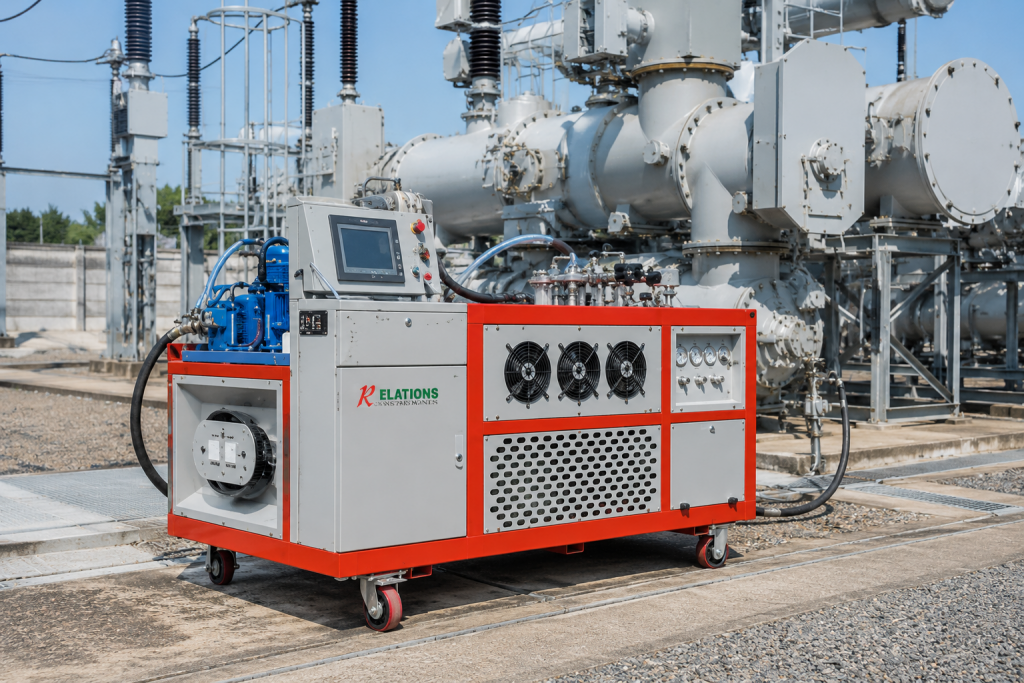
    A suitable SF6 recovery device or SF6 gas service cart helps operators:

    • Recover gas without unnecessary emissions
    • Evacuate switchgear compartments
    • Filter moisture and decomposition products
    • Store and weigh recovered gas
    • Refill equipment at the correct pressure

    SF₆ Lifecycle Solutions from Henan Relations

    Henan Relations Co., Ltd. supplies equipment for different switchgear types and service conditions.

    For full-cycle purification, the RF-300J SF₆ Regeneration System combines recovery, refrigeration, molecular-sieve treatment, storage, weighing, and refilling. Its oil-free compression design supports clean recovery to below 1 mbar and treated purity above 99.9%.

    Der RF-151 and RF-151T handling devices provide PLC-controlled recovery, evacuation, and liquid filling for GIS and circuit breakers up to 220 kV. For routine maintenance of 10–40.5 kV equipment, the compact RF-051 and RF-391 service carts offer convenient mobile operation.

    Additional solutions include:

    • RF-A Modular Recovery System for flexible field configurations
    • Integrated Gas Stations for GIS production lines
    • LM068 Portable Leak Detector for quantitative infrared leak testing
    • RF-MG Series for controlled SF₆/N₂ or SF₆/CF₄ mixtures
    • RF-JFP Portable Refilling Device for filtered cylinder-to-switchgear filling

    Frequently Asked Questions

    Why can’t air simply replace SF₆?

    Air has lower dielectric strength and weaker arc-quenching capability. Replacing SF₆ with air generally requires larger clearances, different interrupter designs, or higher operating pressure.

    Is SF₆ safe for operators?

    Unused SF₆ is non-toxic and non-flammable, but it can displace oxygen in confined spaces. Arc-decomposed gas may contain hazardous byproducts, so ventilation, protective equipment, and proper handling procedures are essential.

    How often should SF₆ gas be tested?

    Testing intervals depend on equipment design, leak history, operating duty, and applicable standards. Gas should also be tested when abnormal density, moisture, leakage, or interruption performance is suspected.

    Can recovered SF₆ be reused?

    Yes. Recovered gas can often be filtered, dried, tested, and reused when it meets the required purity and quality specifications.

    What is the difference between recovery and regeneration?

    Recovery removes SF₆ from equipment and transfers it into storage. Regeneration goes further by removing moisture, particles, oil, und Zersetzungsprodukte, damit das Gas die Anforderungen für eine Wiederverwendung erfüllt.

    Fazit

    SF₆ wird weiterhin häufig eingesetzt, da es eine außergewöhnliche Isolationsfestigkeit, schnelle Lichtbogenlöschung, chemische Stabilität, und eine kompakte Bauweise ermöglicht. Ein verantwortungsvoller Umgang ist ebenso wichtig: in jeder Phase des Lebenszyklus sollten Leckagen minimiert und eine sichere Gasrückgewinnung und Wiederverwendung maximiert werden.

    Henan Relations Co., Ltd. bietet maßgeschneiderte Lösungen für die SF₆-Handhabung, von tragbaren Nachfüllgeräten und Servicewagen bis hin zu Regenerationssystemen und integrierten Gasstationen. Contact the Henan Relations team to select equipment suited to your switchgear voltage, recovery capacity, gas-quality targets, and maintenance workflow.
  • 7 Costly SF6 Switchgear Maintenance Mistakes to Avoid

    7 Costly SF6 Switchgear Maintenance Mistakes to Avoid

    SF6 switchgear maintenance often looks straightforward: check the pressure, connect the equipment, recover the gas and refill the compartment.

    In practice, small mistakes at any stage can waste gas, extend the outage and create problems that may not appear until the equipment is returned to service.

    The following seven mistakes are among the most common—and most avoidable.

    Mistake 1: Refilling Before Finding the Leak

    A falling pressure reading is a warning, not a diagnosis.

    Adding SF6 may restore the pressure temporarily, but it does not solve the cause of the loss. If a valve, flange or sealing surface is still leaking, the new gas may escape again within days or months.

    Before refilling, Techniker sollten die wahrscheinlichen Leckagestellen überprüfen:

    • Ventile und Ventilanschlüsse
    • Flansche und Dichtflächen
    • Anschlüsse des Dichtewächters
    • Rohrverbindungen
    • Durchführungen und Schnittstellen zwischen Kammern
    • Bei früheren Wartungsarbeiten verwendete Schläuche

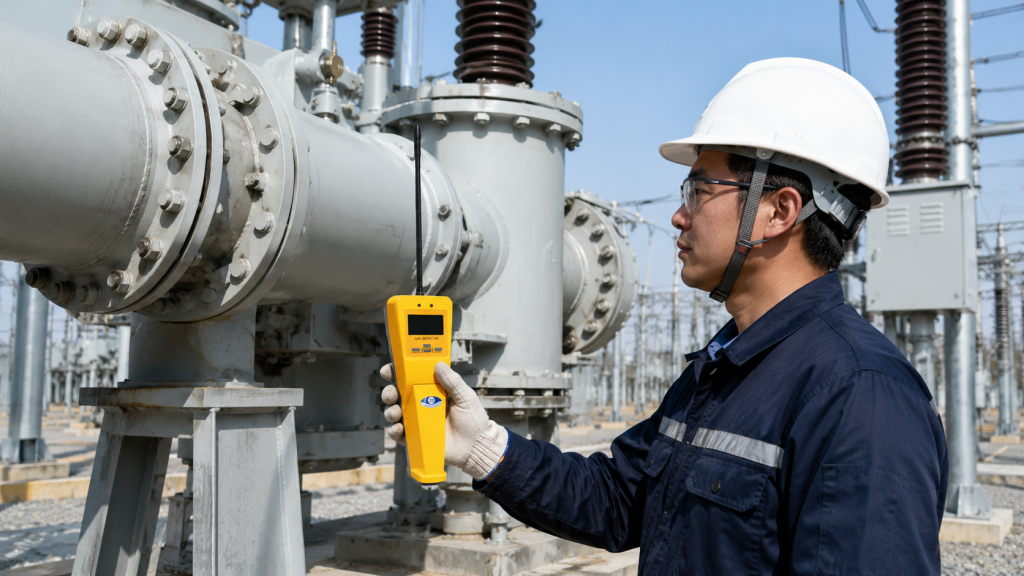
    Tragbarer SF6-Leckdetektor von Relations ist hilfreich, um ein bestimmtes Leck zu lokalisieren. In einem GIS-Innenraum oder einer unterirdischen Umspannstation, kann ein fest installiertes Überwachungssystem kontinuierlich warnen, wenn die SF6-Konzentration in der Umgebung ansteigt.


    Mistake 2: Beurteilung der Gasqualität allein anhand des Drucks

    Pressure tells you how much gas may be in the compartment. It does not tell you whether the gas is clean enough to reuse.

    Gas with an acceptable pressure may still contain:

    • Excessive moisture
    • Air introduced during maintenance
    • Oil or particles
    • SF6 decomposition products
    • Other contaminants

    Before recovered gas is reused, it should be tested for the parameters required by the maintenance procedure. Purity, moisture or dew point, and decomposition products are normally the key measurements.

    The test result determines whether the gas can be reused after normal filtration, requires additional treatment, or should be sent to a regeneration system.

    Without analysis, technicians are making a decision without the information they actually need.

    Mistake 3: Selecting a Service Cart by Flow Rate Alone

    A large compressor number may look impressive on a product sheet, but it does not describe the complete recovery process.

    Recovery speed changes as the pressure inside the gas compartment drops. A machine that performs well at higher pressure may slow down considerably near the end of recovery.

    Equipment selection should also consider:

    • Gas compartment volume
    • Required final recovery pressure
    • Available storage capacity
    • Whether gas will be stored as a gas or liquid
    • Hose length and connection size
    • Ambient temperature
    • Required recovery time
    • Frequency of maintenance work

    For a small ring main unit, a compact mobile service cart may be enough. Large GIS compartments, switchgear production lines and centralized gas-treatment projects require a different configuration.

    The right question is not “Which machine has the biggest compressor?” It is “Which system can complete the entire job within the required time?”

    Mistake 4: Forgetting the Air Inside Hoses and Connections

    A switchgear compartment may be properly evacuated, but the maintenance result can still be compromised by air trapped inside the hoses.

    When an unevacuated hose is opened to the compartment, the trapped air and moisture may enter the electrical equipment. The quantity may appear small, but repeated maintenance can gradually affect gas purity and moisture levels.

    Before recovery or refilling:

    1. Check that the hoses are clean and dry.
    2. Inspect seals and connections.
    3. Evacuate the hose and manifold.
    4. Confirm valve positions before opening the gas path.
    5. Use self-sealing couplings where appropriate.

    This is a simple step, but it is often the difference between controlled gas handling and accidental contamination.

    Mistake 5: Treating Purification and Regeneration as the Same Process

    Purification and regeneration are related, but they are not always interchangeable.

    A service cart usually purifies recovered SF6 by passing it through filters and drying materials. This process can remove or reduce moisture, particles, oil and certain decomposition products.

    Regeneration is intended for gas that requires deeper and more controlled treatment. It may involve repeated circulation, several treatment stages, larger adsorbent systems and testing before the gas is approved for reuse.

    In practical terms:

    • Purification is often part of routine recovery and maintenance.
    • Regeneration is used when ordinary filtration is not enough.

    Sending every batch of gas for full regeneration wastes time and operating cost. Reusing heavily contaminated gas after basic filtration creates a different risk.

    Gas analysis should determine which process is required.

    Mistake 6: Refilling to a Pressure Number Without Considering Temperature

    Gas pressure changes with temperature.

    If a compartment is filled on a cold morning and checked again during a hot afternoon, the pressure reading may be different even though no gas has leaked.

    This is why technicians should not treat the pressure gauge as an isolated number.

    A controlled refilling process should consider:

    • Ambient temperature
    • Equipment temperature
    • The manufacturer’s filling requirements
    • Gas density or temperature-compensated pressure
    • Stabilization time after filling
    • Accuracy of the regulator and measuring instruments

    Filling too quickly can also produce unstable readings. After reaching the target condition, allow the gas and equipment temperature to stabilize before confirming the final value.

    Finally, inspect every connection that was opened during maintenance.

    Mistake 7: Ending the Job Without Records or a Final Check

    A maintenance job is not complete when the hose is disconnected.

    Without proper records, the next technician cannot tell whether a falling pressure is a new problem or part of a longer trend.

    A useful maintenance record should include:

    • Equipment and compartment identification
    • Initial pressure or density
    • Leak inspection result
    • Gas purity and moisture values
    • Decomposition-product readings
    • Amount of gas recovered
    • Treatment method
    • Vacuum level
    • Amount of gas refilled
    • Final pressure or density
    • Operator and maintenance date

    The final check should also confirm that valves are closed, caps are fitted, connections are clean and no leakage is detected.

    Good records turn a single maintenance visit into useful information for the next inspection.

    Better SF6 Maintenance Starts With the Whole Process

    The most expensive maintenance mistakes rarely come from one dramatic failure. They usually come from small steps that were skipped, rushed or never recorded.

    A reliable SF6 maintenance process connects:

    Leak detection → Gas analysis → Recovery → Purification or regeneration → Vacuum evacuation → Controlled refilling → Documentation

    SF6 in Switchgear provides equipment for each stage, including leak detectors, room monitoring systems, gas analyzers, SF6-Servicewagen, vacuum pump units, filling equipment and gas-regeneration systems.

    The equipment should be selected according to gas volume, required recovery time, final pressure, gas condition and site working conditions—not by one specification alone.

    Need Help Selecting SF6 Handling Equipment?

    Send us the following information:

    • Gas compartment volume
    • Required recovery time
    • Final recovery pressure
    • Storage method
    • Power supply
    • Gas condition
    • Application and site environment

    Relations will recommend a suitable configuration for your maintenance or production process.

  • Warum sollte im Jahr 2026 SF6-Gas in Hochspannungsschaltanlagen eingesetzt werden?

    Warum sollte im Jahr 2026 SF6-Gas in Hochspannungsschaltanlagen eingesetzt werden?

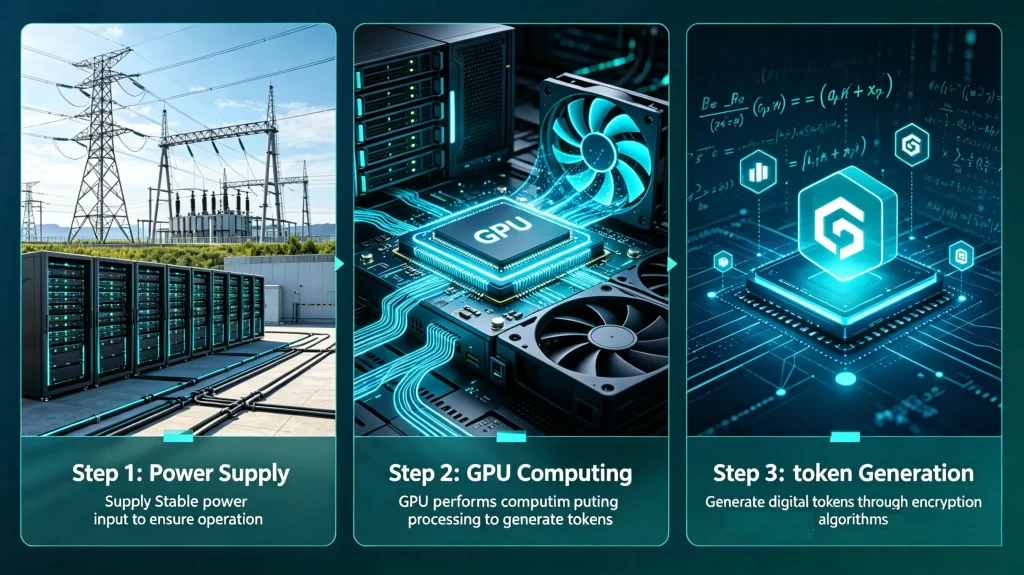
    Currently, artificial intelligence (AI) is experiencing rapid global growth and has become a core driver of transformation across various industries. The entire technological chain, from the power supply and high-performance GPUs that support AI operations to the token computing required for AI model training and inference, is evolving and placing higher demands on the power supply system — it needs not only greater power capacity but also extreme stability and reliability. It is worth noting that a single training session for a large-scale AI model can consume 12 million kWh of electricity, and an AI server equipped with 8 H100 chips uses as much as 120,000 kWh of electricity annually. This surging demand for power has made grid stability a crucial bottleneck restricting the continuous development of AI. As an indispensable part of the power system, high-voltage switchgear serves as the “core hub” responsible for controlling circuit on-off, isolating faults, and ensuring the safe operation of the power grid, making it a key piece of equipment in the transmission and distribution of electricity. With the continuous expansion and upgrading of the power system to meet AI’s growing energy needs, high-voltage switchgear is being used in more and more scenarios. Consequently, various issues related to the handling of its core gas have become increasingly prominent. Today, we will focus on the core question and analyze Warum sollte im Jahr 2026 SF6-Gas in Hochspannungsschaltanlagen eingesetzt werden?

    power to token
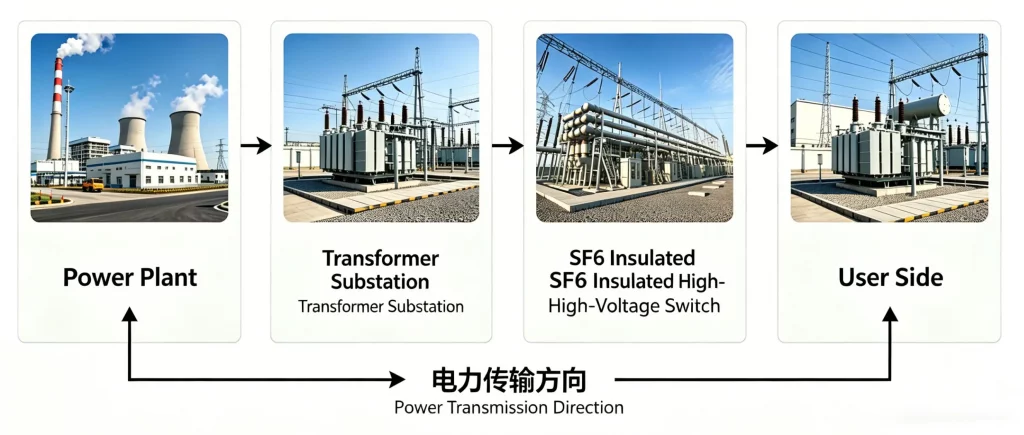
    • Background: High-voltage switches are like the “key gate keepers” in the power system. They control the on and off of circuits and protect the safe and stable operation of the entire power grid, just as important as the “smart valves” on the power transmission path.
    • Core question: High-voltage switches have very high requirements for insulation and arc extinguishing. There are so many gases on the market, why can SF6 gas stand out and become the “exclusive partner” of high-voltage switches?
    • In fact, SF6 gas has many “special skills”. Next, let’s break them down step by step to see what magical abilities it has that make high-voltage switches “fond of it”.
    Warum sollte im Jahr 2026 SF6-Gas in Hochspannungsschaltanlagen eingesetzt werden?

    I. Excellent Arc Extinguishing Ability

    1. If high-voltage switches are the “gate keepers”, then SF6 gas is their “personal explosion-proof shield”, specially solving the safety trouble of electric arcs generated when circuits are disconnected.
    2. Arc Extinguishing Principle: When the circuit is disconnected and a dazzling electric arc is generated, SF6 gas will “take action” immediately, quickly absorb the electrons in the arc, turn them into negative ions, and make the arc lose its conductivity.
    3. Performance Advantage: Its arc extinguishing speed is surprisingly fast — it can “put out” the arc in just 0.01 seconds, and it can easily handle even high-voltage scenarios.
    4. Practical Application: With it, even if the high-voltage switch needs to cut off a large current of 100,000 amperes, no dangerous sparks will appear. It can not only protect the equipment from damage but also ensure the safety of the staff.

    II. Excellent Insulation Performance

    1. Core Position: In addition to its excellent arc extinguishing ability, SF6 gas’s insulation capacity is far superior to ordinary air. It’s like putting a layer of “insulation protective clothing” on the high-voltage switch to prevent the equipment from leakage.
    2. Density Advantage: It is 5 times heavier than air, so it can stay steadily inside the high-voltage switch, forming a stable gas protective layer. It effectively blocks the random movement of charged particles and greatly reduces the risk of leakage.
    3. Molecular Structure Advantage: The molecule of sulfur hexafluoride is very “symmetrical”. This stable structure can make the electric field distribution more uniform, avoiding excessive local electric field that leads to insulation breakdown (or “insulation failure”).
    4. Environmental Adaptability: Its “adaptability” is also super strong. Whether in the severe cold of minus 50℃ or the high temperature of 150℃, it can maintain stable insulation performance, making it reliable for use in any region.

    III. The Irreplaceable Advantages of SF6 Gas in High-Voltage Switches

    1. Strong Chemical Stability: SF6 gas has a very “calm temper”. It is not easy to react with other substances, will not corrode the internal parts of the high-voltage switch, and can help the equipment “extend its service life”.
    2. High Volume Efficiency: It is in a gaseous state, so it is very convenient to fill. Even if the internal space of the high-voltage switch is limited, it can give full play to the functions of insulation and arc extinguishing, and also simplify the structural design of the equipment.
    3. Comparative Advantage: Compared with traditional insulation and arc extinguishing media (such as air and oil), SF6 gas has stronger comprehensive strength. It can fully meet the needs of high-voltage and large-capacity power systems and is difficult to be replaced.
    Warum sollte im Jahr 2026 SF6-Gas in Hochspannungsschaltanlagen eingesetzt werden?

    IV. Summary

    • It is precisely because SF6 gas has both excellent arc extinguishing ability and outstanding insulation performance that it has become the “ideal partner” of high-voltage switches, silently guarding the safe and efficient operation of the power system.
    • As the power system becomes more and more advanced and develops towards high voltage and large capacity, the application of SF6 gas will become more and more extensive. At the same time, Wir werden auch den Umweltschutz berücksichtigen und die Recyclingtechnologie für SF6-Gas kontinuierlich verbessern..